header-logotype
7AM - MIDNIGHT | 7/365
BOOK NOW

What Do Lice Actually Look Like? A Parent's Identification Guide

What Do Lice Actually Look Like? A Parent's Identification Guide
Created on 
August 22, 2026
Updated on 

The first time most parents look for lice, they have no idea what they're actually looking for. They expect something obvious — bugs crawling visibly through the hair. What they find is more subtle than that, and easier to miss than anyone warns them.

Here's what lice actually look like at each stage, where they hide, and how to tell them apart from the things they get confused with.

Adult Lice

A fully grown adult louse is about the size of a sesame seed — roughly 2 to 3 millimeters. According to the CDC, adult lice are tan to grayish-white. On dark hair they appear darker; on lighter hair they can look almost translucent. They have six legs, each tipped with a claw designed to grip a hair shaft.

The harder part: they move fast. Lice can crawl up to 23 centimeters per minute and they actively avoid light. Part the hair to check the scalp and they scatter. This is why combing with a fine-tooth metal comb on wet, conditioned hair catches more than a visual inspection alone.

Nymphs (Baby Lice)

Nymphs are newly hatched lice. They're much smaller than adults — roughly the size of a pinhead — and lighter in color, almost clear or pale yellow when they first hatch. They darken as they mature, which takes about 9 to 12 days.

Because of their size and color, nymphs are easy to miss, particularly on lighter or blonde hair. A thorough metal comb-through on damp hair is the most reliable way to catch them.

Nits (Lice Eggs)

Nits are what most parents find first, and what most people have trouble identifying correctly.

A nit is a lice egg laid by a female louse and glued to a single hair shaft close to the scalp. They're oval-shaped, roughly 0.8 millimeters long — smaller than a nymph — and attached at an angle to the hair strand. Unhatched nits are yellowish or tan. Hatched nits (empty casings) are white or clear and easier to see against dark hair.

The key to identifying a nit vs. dandruff or product buildup: nits don't move when you try to slide them down the hair shaft. They're cemented on with a protein secretion. Dandruff flakes off. Product buildup slides. A nit stays put.

Where to Look First

The CDC notes that lice and nits are most commonly found at the nape of the neck, behind the ears, and along the hairline. These are the warmest parts of the scalp, where lice prefer to lay eggs. In a check, start there.

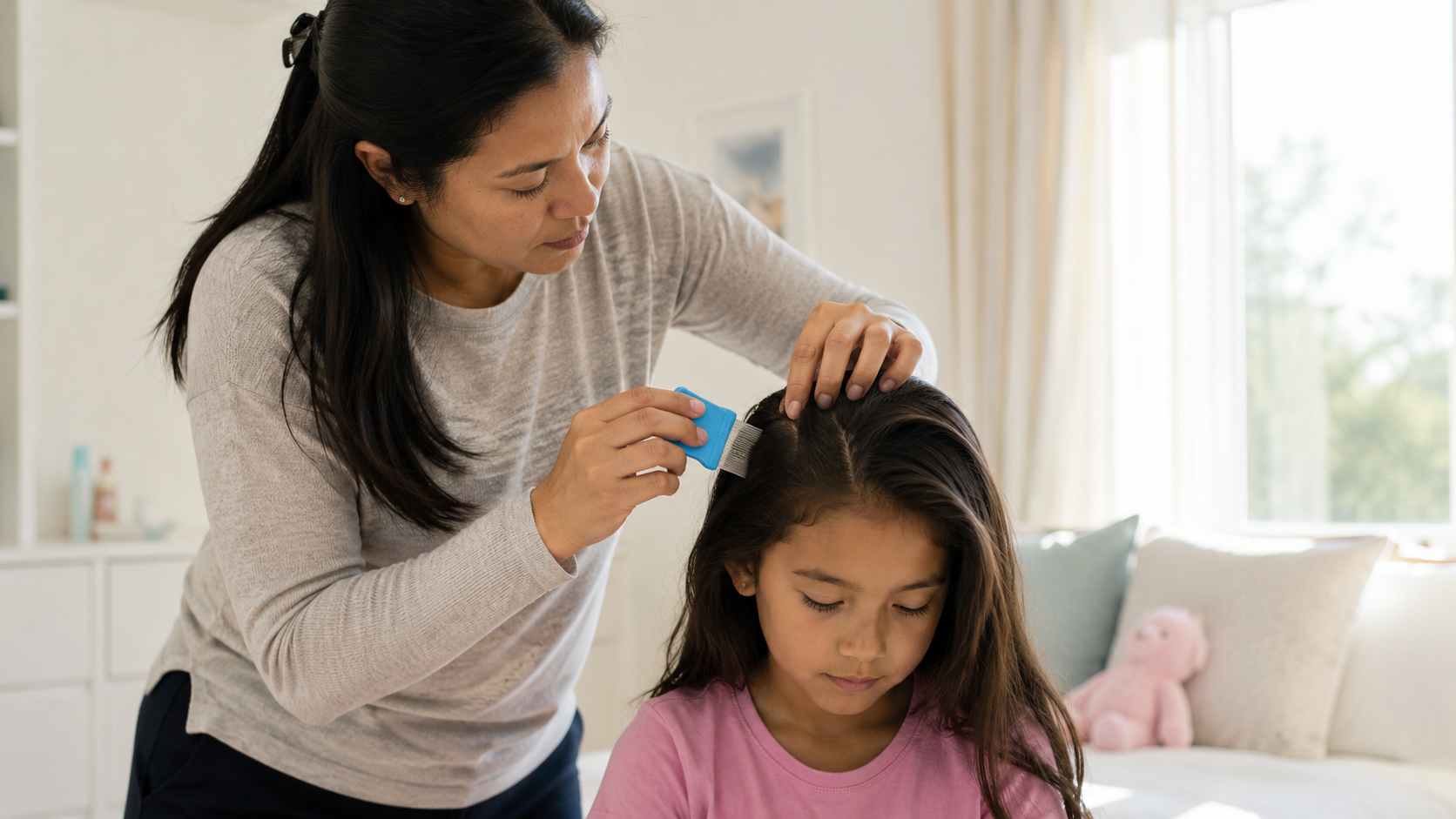
Use a fine-tooth metal comb on damp, conditioned hair. Work in sections. Wipe the comb on a white paper towel after each pass — nits and lice show up clearly against white. Good lighting, ideally a lamp directed at the scalp rather than overhead ceiling lighting, makes a real difference.

What Lice Get Confused With

Dandruff: Dandruff is white, flat, and comes off the hair shaft easily. Nits are oval, attached at an angle, and won't slide or brush off.

Hair casts: These are thin, tube-like structures of keratin that encircle the hair shaft and slide freely up and down when you push them. They look somewhat like nits at a glance but move easily.

DEC plugs: Small white or yellowish deposits from the scalp's sebaceous glands. These are rounder and less elongated than nits and detach easily.

Residue from hair products: Styling products can leave white or yellowish deposits on the hair shaft. These slide off or rub away; nits don't.

If you found something attached to the hair shaft that won't slide off and you're not certain, a professional screening can confirm it quickly. LiceDoctors technicians screen for lice 7 days a week and can tell you definitively what you're dealing with before any treatment decision is made.

Heading

Lorem ipsum dolor sit amet, consectetur adipiscing elit. Suspendisse varius enim in eros elementum tristique. Duis cursus, mi quis viverra ornare, eros dolor interdum nulla, ut commodo diam libero vitae erat. Aenean faucibus nibh et justo cursus id rutrum lorem imperdiet. Nunc ut sem vitae risus tristique posuere.

Book Appointment

We provide a friendly in-home lice removal service

Book your appointment today

Found something in the hair and not sure what it is?

LiceDoctors can screen and confirm same day, 7 days a week. Call us before you spend money on treatment for something that might not be lice.

Book a Screening or call 800-224-2537

How small are lice?Adult lice are about the size of a sesame seed — 2 to 3 millimeters. Nymphs (newly hatched lice) are much smaller, roughly pinhead-sized. Nits (eggs) are even smaller, about 0.8 millimeters.

What color are lice?Adult lice are tan to grayish-white and darken slightly after feeding. They may appear darker on dark hair and more translucent on lighter hair. Newly hatched nymphs are pale yellow or almost clear.

How do I tell nits apart from dandruff?Nits don't slide. They're glued to the hair shaft with a protein secretion and won't move when you run a fingernail along the strand. Dandruff flakes off easily. That single test tells you more than anything else.

Where are lice most likely to be hiding?The nape of the neck and behind the ears — the warmest areas of the scalp — are where lice lay eggs first. Start any check there.

Can I see lice without a comb?Sometimes, but it's unreliable. Lice move fast and avoid light. A fine-tooth metal comb on damp, conditioned hair is far more effective than a visual scan of dry hair.

Text?

WHAT TO DO IF MY BABY HAS LICE?

Doctor smiling and gently touching a young girl's head as her mother watches nearby.
Updated on August 18, 2020

If you are a new or first time parent like I was who has heard the horror stories of families being unable to get rid of lice easily, or who has had experience with head lice as a child, one of the many things that may be of concern would be is there a chance of lice in infants or lice in toddlers hair?

Read more

WHAT TO DO IF MY BABY HAS LICE?

Doctor smiling and gently touching a young girl's head as her mother watches nearby.
Updated on August 18, 2020

If you are a new or first time parent like I was who has heard the horror stories of families being unable to get rid of lice easily, or who has had experience with head lice as a child, one of the many things that may be of concern would be is there a chance of lice in infants or lice in toddlers hair?

Read more
LOAD MORE

RECOMMENDED POSTS

No items found.
Cart
0

WHAT TO DO IF MY BABY HAS LICE?

Doctor smiling and gently touching a young girl's head as her mother watches nearby.
Updated on August 18, 2020

If you are a new or first time parent like I was who has heard the horror stories of families being unable to get rid of lice easily, or who has had experience with head lice as a child, one of the many things that may be of concern would be is there a chance of lice in infants or lice in toddlers hair?

Read more

WHAT TO DO IF MY BABY HAS LICE?

Doctor smiling and gently touching a young girl's head as her mother watches nearby.
Updated on August 18, 2020

If you are a new or first time parent like I was who has heard the horror stories of families being unable to get rid of lice easily, or who has had experience with head lice as a child, one of the many things that may be of concern would be is there a chance of lice in infants or lice in toddlers hair?

Read more
LOAD MORE