
.svg)
.svg)

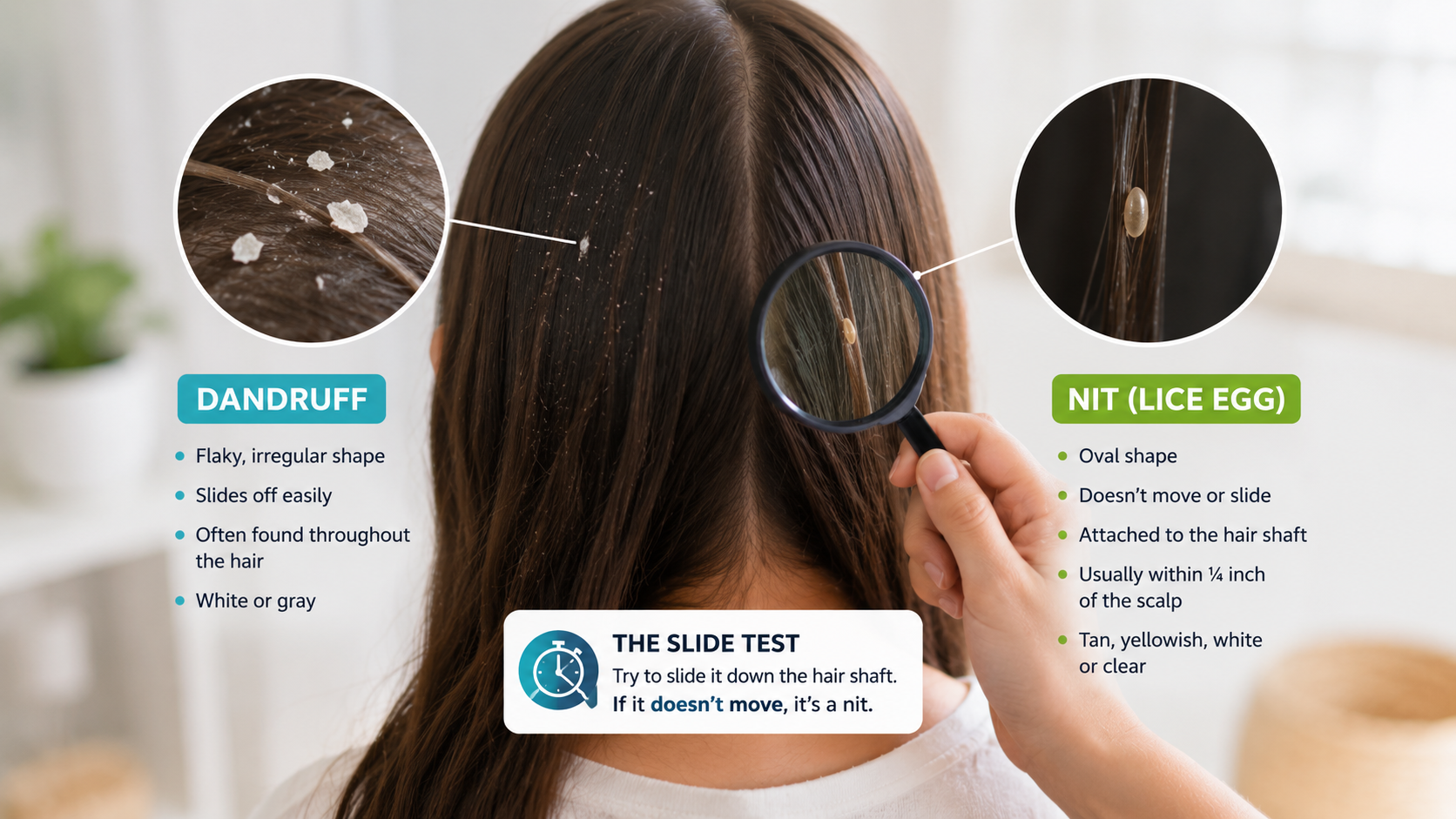

Every year, parents spend money treating lice that turns out to be dandruff. And some parents treat dandruff for weeks before realizing it's lice. The two look similar enough at a glance that the confusion makes sense — but there's a one-second test that settles it immediately.
The Slide Test
Take one of the white or yellowish specks between your fingernail and the hair shaft and try to slide it downward toward the end of the hair. Do it with intention, not a light brush.
Dandruff slides off easily or falls away. Product buildup does too.
A nit doesn't move. It's glued to the hair shaft with a protein secretion that's strong enough that you have to grip it deliberately to pull it off. If it doesn't budge when you try to slide it, it's a nit.
That test is faster and more reliable than any visual comparison.
Visual Differences
If you want a visual check on top of the slide test:
Dandruff is flat, irregular in shape, and usually white or grey. It tends to cluster near the scalp but also appears throughout the hair. It brushes away easily.
Nits are oval and slightly elongated — the CDC describes them as about 0.8 millimeters long. They're attached at an angle to a single hair strand, not scattered across multiple strands. Unhatched nits are tan or yellowish. Empty (hatched) casings are white or clear and slightly deflated-looking.
Location matters too. Nits are almost always within a quarter inch of the scalp in an active infestation — female lice lay eggs close to the warmth of the scalp. Finding specks only at the ends of the hair, far from the scalp, is more consistent with dandruff or product residue than nits.
Other Signs That Point to Lice
If you've done the slide test and found something that doesn't move, look for these alongside it:
Persistent scalp itching, particularly at the nape of the neck and behind the ears. This is where lice prefer to lay eggs and feed.
Live bugs in the hair. They're small — about sesame-seed size — tan to grayish-white, and fast-moving. If you spot something moving in the hair, it's a louse, not dandruff.
Multiple nits on multiple strands close to the scalp. A single questionable speck might be debris. Multiple oval specks that don't slide, spread across the hairline and behind the ears, is a different situation.
Still Not Sure? Get a Professional Check
If you've done the slide test and you're still uncertain, a LiceDoctors technician can confirm it in minutes. She uses a professional headlamp and metal comb and does this all day — she'll know immediately whether what you found is lice or something else.
LiceDoctors is available 7 days a week, same day in most areas. If it turns out to be lice, the treatment happens in the same visit. If it's not lice, you'll know for certain before spending money on treatment you don't need.
Call 800-224-2537 or book online.
.webp)
