header-logotype
7AM - MIDNIGHT | 7/365
BOOK NOW

What Happens If You Only Treat One Family Member for Lice?

What Happens If You Only Treat One Family Member for Lice?
Created on 
June 23, 2026
Updated on 
June 23, 2026

You treated your kid. You did everything right. And two weeks later, the lice are back.

This is one of the most common things parents run into, and almost every time, the reason is the same: someone else in the house still has them.

Lice don't need much. Close contact, a few seconds of head-to-head touch, and they're moving again. Treating one person while others go unchecked is like patching one hole in a net. The case just keeps cycling.

Why lice come back after treatment

When a child is found to have lice, the instinct is to treat that child and move on. That's understandable. But by the time lice are discovered on one person, the infestation has usually been going on for several weeks. According to the CDC, lice spread almost entirely through direct head-to-head contact, which means anyone sharing a bed, a couch, or close daily space with the affected child is a likely candidate.

Nits (lice eggs) are laid within a quarter inch of the scalp and are virtually invisible to the untrained eye. A family member can carry them for weeks without itching or any other obvious sign. You treat one person, they pick it back up from an untreated sibling or parent within days, and the cycle starts over.

Who actually needs to be checked

Everyone in the household. Not just the kids. Parents and adults who share sleeping spaces or spend time in close physical contact with the affected person should be checked too.

The American Academy of Pediatrics recommends that household members and other close contacts be checked whenever a case is identified. Only those who are found to have live lice or viable nits need to be treated — but everyone needs to be looked at first.

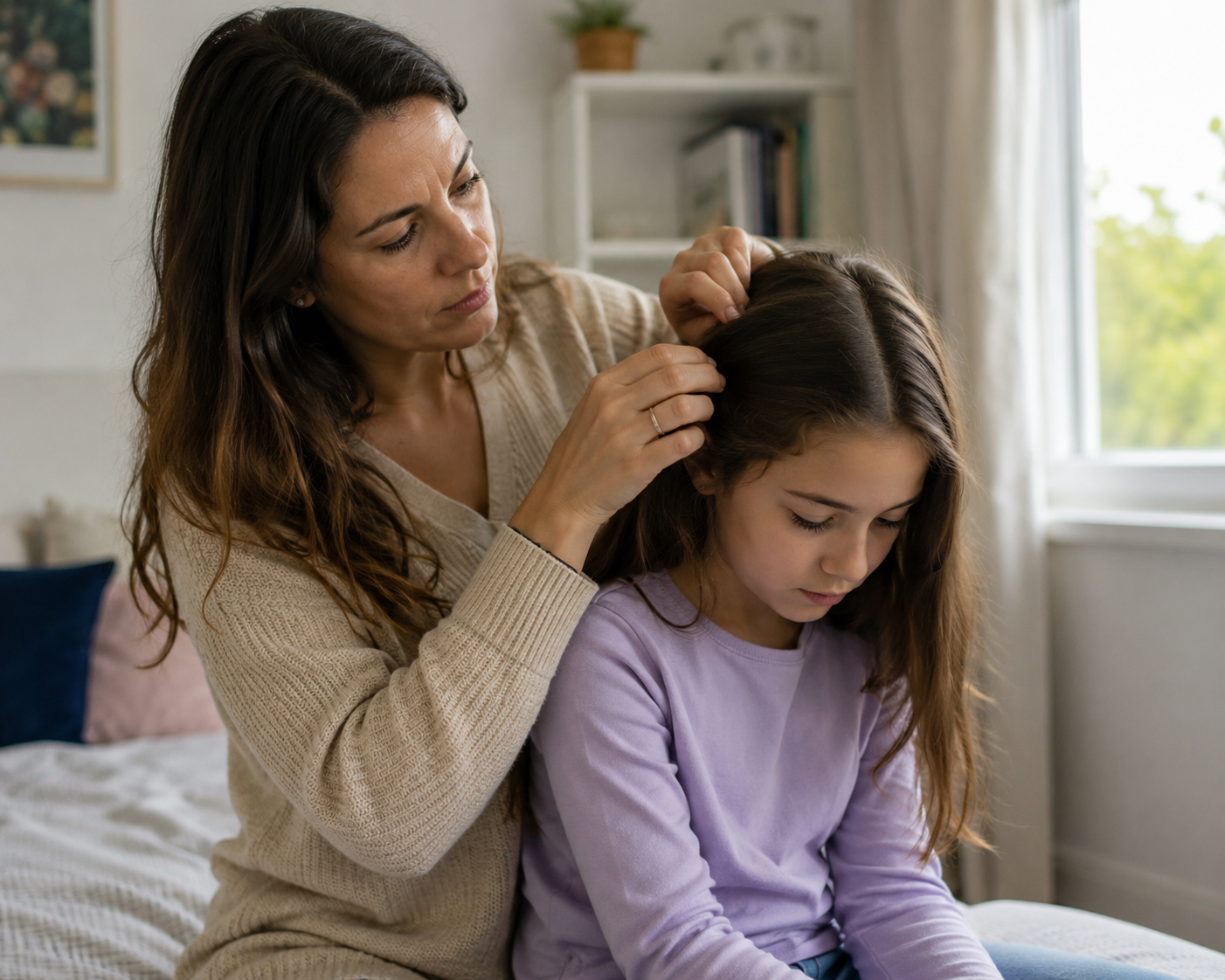
A quick check takes about five minutes per person. What you're looking for: live lice (sesame seed-sized, tan to gray, move fast) and nits (tiny oval eggs attached tightly to the hair shaft close to the scalp, won't flick off). Start behind the ears and at the nape of the neck — that's where lice spend most of their time.
The reinfection loop nobody talks about

Here's what usually happens in a household that only treats one person:

Child A gets treated. Child B has lice but no symptoms yet, so nobody checks. Child A and Child B share a bed or watch TV together a few days later. Child A gets lice again. Parents assume the first treatment failed.

The treatment didn't fail. The source was never addressed.

This is especially common with younger siblings and with parents who tend to be the ones doing the close combing and checking. Moms in particular frequently end up with cases they didn't realize they had, picked up during the process of treating their kids.

What a proper household check looks like

Wet hair and a fine-tooth lice comb are all you need. Work in two-inch sections from the scalp outward, wiping the comb on a white towel after each pass. Anything on the towel that's tan, brown, or oval-shaped needs a closer look.

Check everyone the same day if you can. The point is to find any cases at the same time so treatment can happen simultaneously, cutting off the reinfection loop before it starts.

If you find lice or nits on more than one person, everyone affected should be treated at the same time, not one at a time over several days.

When to call a professional

DIY checks are completely reasonable, but they're also easy to get wrong. Nits look a lot like dandruff or product buildup to most people, and lice move fast enough that a quick look misses them. If you've treated someone more than once and lice keep coming back, the most likely explanation is that someone else in the home hasn't been properly cleared.

LiceDoctors technicians screen and treat entire households in a single visit. If multiple family members have lice, everyone can be treated the same night — no second trips, no back-and-forth. The 99.6% success rate and 30-day guarantee cover the whole case, not just one person.

Call LiceDoctors at 800-224-2537. Available 7am to midnight, 7 days a week including holidays.

Book an appointment

Heading

Lorem ipsum dolor sit amet, consectetur adipiscing elit. Suspendisse varius enim in eros elementum tristique. Duis cursus, mi quis viverra ornare, eros dolor interdum nulla, ut commodo diam libero vitae erat. Aenean faucibus nibh et justo cursus id rutrum lorem imperdiet. Nunc ut sem vitae risus tristique posuere.

Book Appointment

We provide a friendly in-home lice removal service

Book your appointment today

Lice keep coming back? It's probably not the treatment. LiceDoctors checks and treats the whole household in one visit. Call 800-224-2537 or book online. Available 7am to midnight, 7 days a week.

Do I need to treat everyone in the house if one person has lice?
Everyone should be checked. Anyone found with live lice or viable nits should be treated. Skipping household members is the most common reason lice keep coming back after treatment.

What if only one person has symptoms?
Symptoms — mainly itching — can take four to six weeks to appear after a case starts. By the time someone is scratching, others in the household may already have lice without knowing it. Check everyone regardless of symptoms.

Can a parent get lice from their child?
Yes. Parents who do close combing, cuddling, or hair checks on their kids are at real risk of picking up lice themselves. Adults are just as susceptible as kids through head-to-head contact.

What if the lice came back after treatment?
If lice return within a few weeks, the most likely cause is an untreated household member, not a failed treatment. Start by checking everyone in the home again. If you're not sure what you're looking at, call LiceDoctors at 800-224-2537 for a professional screening.

Text?

WHAT TO DO IF MY BABY HAS LICE?

Doctor smiling and gently touching a young girl's head as her mother watches nearby.
Updated on August 18, 2020

If you are a new or first time parent like I was who has heard the horror stories of families being unable to get rid of lice easily, or who has had experience with head lice as a child, one of the many things that may be of concern would be is there a chance of lice in infants or lice in toddlers hair?

Read more

WHAT TO DO IF MY BABY HAS LICE?

Doctor smiling and gently touching a young girl's head as her mother watches nearby.
Updated on August 18, 2020

If you are a new or first time parent like I was who has heard the horror stories of families being unable to get rid of lice easily, or who has had experience with head lice as a child, one of the many things that may be of concern would be is there a chance of lice in infants or lice in toddlers hair?

Read more
LOAD MORE

RECOMMENDED POSTS

How to Tell Another Parent Your Child Has Lice
Created on 
June 20, 2026
Updated on 
June 20, 2026

How to Tell Another Parent Your Child Has Lice

Found out your child has lice? Here's how to tell other parents — what to say, when to say it, and why it actually helps everyone.

Read more
How to Check Your Child's Hair for Lice
Created on 
January 17, 2025
Updated on 

How to Check Your Child's Hair for Lice

Learn how to check your child’s hair for lice with this step-by-step guide. Discover the tools you need, how to spot lice and nits, and what to do if you find an infestation.

Read more
Cart
0

WHAT TO DO IF MY BABY HAS LICE?

Doctor smiling and gently touching a young girl's head as her mother watches nearby.
Updated on August 18, 2020

If you are a new or first time parent like I was who has heard the horror stories of families being unable to get rid of lice easily, or who has had experience with head lice as a child, one of the many things that may be of concern would be is there a chance of lice in infants or lice in toddlers hair?

Read more

WHAT TO DO IF MY BABY HAS LICE?

Doctor smiling and gently touching a young girl's head as her mother watches nearby.
Updated on August 18, 2020

If you are a new or first time parent like I was who has heard the horror stories of families being unable to get rid of lice easily, or who has had experience with head lice as a child, one of the many things that may be of concern would be is there a chance of lice in infants or lice in toddlers hair?

Read more
LOAD MORE