.svg)
.svg)

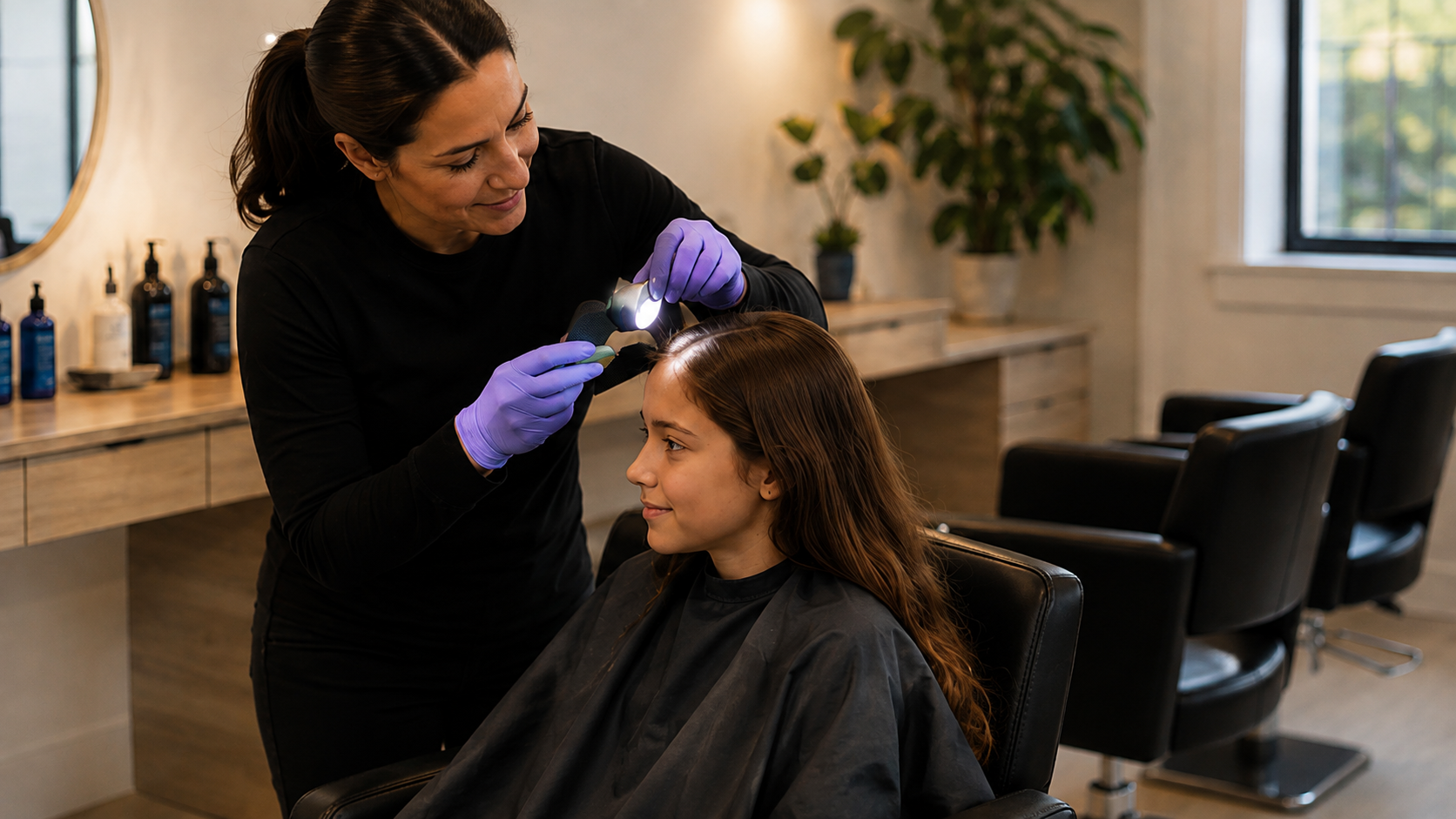

Most families don't know there's an alternative to the lice salon until they've already paid $400 per person and driven across town with three itchy kids. Here's how in-home lice treatment compares to a salon visit on every dimension that actually matters.
Why Pay for a Professional Lice Treatment Service?
When can I go to the pharmacy and buy an over-the-counter treatment? Why pay for an in-home lice removal service? Those are questions that many people mull over when trying to decide their first line of fire when getting rid of head lice in-home on their own. Frankly, the majority of our clients have taken the pharmacy route and have found that the OTC products do NOT work. The reason for that is two-fold: the chemical treatments no longer are reliable in killing the bugs as the bugs have mutated and become resistant to the chemicals. The second factor is that the chemicals do not penetrate the shell of the nits so the nits are left on the head to hatch. Even if a person is successful at combing out most of the nits, usually he or she misses a few as these nits camouflage and are difficult to find. Families want the best head lice treatment, so many today are considering professional in-home lice removal.
Some Basic Lice Facts
Here are some facts: Nix (1% permethrin) has been found to be effective less than 70% of the time in eradicating LIVE bugs, which means that on average in about a third of cases lice are left in the hair. Prescription shampoos like Ivermectin and Malathion may have unpleasant side effects and also do not penetrate In these treatment options, the products do not claim to eradicate the nits. You are still left with the job of removing all of the nits. This is a very time-consuming and often futile exercise unless one is trained and very experienced on how to treat head lice at home. Often parents end up missing work, children miss school, lots of money is wasted on useless treatments and the frustration level in the house is at an all-time high. After these treatments fail, and money has already been spent, many families begin to seek out alternative treatment options, looking for the best products for head lice or in-home lice removal services.
Benefits of In-home Lice Treatment

We know there are many routes you can take to try to eliminate head lice. We are a lice removal company that has been treating head lice for 20 years providing in-home lice treatment services. Below are the reasons we believe that professional in-home head lice removal is your best option.
- In-home treatment works best for families with busy schedules — In today's world, multiple kids mean multiple schedules. In-home treatment allows each child to return to his or her routine after being treated rather than having to sit at a salon waiting for siblings.
- The in-home treatment eliminates the risk of picking up a case at a salon — The whole family should be checked. It's possible that one of the children will be lice-free and there is no need to expose the child to a facility that caters to people who are infested.
- In-home lice treatment is the most private option — While head lice are very prevalent, in fact, several million children will get them this year, there is still a bit of a stigma attached to it. That is very unfortunate, but, nonetheless true. Most people want their privacy when it comes to head lice.
- In-home treatment has lower overhead and therefore should have lower prices — Salons often charge by the head and treatment for a family of four can run as high as $800. LiceDoctors’ average charge for a family of four is under $400.
- In-home treatment allows you to get to work changing the sheets while your children are being treated — At LiceDoctors we say it is the head, not the house that needs treating because lice will die when off the head. Nonetheless, we know that many people prefer to change their sheets and you can get started while we are working on the heads.
- Let’s face it young children are more comfortable at home in their own environment.
Five Reasons In-Home Treatment Beats a Lice Salon
You see a bug crawl off your child’s head. Your schedule is busy and who needs this aggravation? What makes more sense? Choice one is you make an appointment and interrupt everyone’s schedule to bring them to a lice clinic OR you call LiceDoctors, go about your business, and wait for them to come to you to treat everyone at home?
In today’s busy world, it is rare to find the level of service that LiceDoctors provides to families. Pick up the phone, call for help, and the rest is on us. LiceDoctors is a service-oriented company and our goal is to make sure that your lice experience is as positive as can be.
Here are five major reasons why LiceDoctors makes house calls rather than treating clients in a salon setting.
Convenience

Let’s be honest. Is there a more demanding job than being a parent? Whether you work outside the home or are an at-home parent, there are a million demands on your time. When your child gets says head lice, that can really tip the balance from relative sanity to chaos. That is why your technician makes the treatment as convenient as possible for you by coming right to your home. That is one fewer place to which you have to drive your child(ren).
Flexibility
Your tech comes to you at a time you designate, which may be late at night or early in the morning, on a week day or a Saturday or Sunday or a holiday. We don’t operate on store/salon hours because neither do head lice. You need us, we come. Also, when child one is finished, he or she can carry on with activities rather than waiting at a salon for Mom or child 2 to be checked and or treated.
Privacy

Thankfully, as so many kids today get head lice, the stigma has lessened. Nonetheless, many people want to keep their lice news to themselves. House calls (all our cars are unmarked) allow you to decide whom you want to tell and when. In other words, it eliminates the risk of bumping into your nosy neighbor as you are entering the lice salon.
This goes double for older children and teenagers. Sadly, there may still be a social stigma associated with head lice, and teenagers are particularly sensitive to that. They have enough on their plates and they may not want to share the news with others that they have lice. If they do, that’s up to them. Nonetheless, going to a lice salon, a public place, takes that choice away from them and you.
Alternatively, receiving lice treatment in your own home is your private business. You want friends to know? That is fine. Want to keep it to yourself? That is also your choice. Nothing is more private than a house call.
Pricing
LiceDoctors’ pricing is generally a lot less than salons. Our overhead is lower and we pass that savings on to you. While a salon may charge $150 or more per person ($600+ for a family of 4), our pricing for 4 people averages less than $375 (including travel). After all, we don't have to pay for rent, heat, and idle employees like a salon does.
Less Risky

Imagine people sitting in the waiting room of a lice treatment salon. You know the drill. You sit and wait and the chairs are lined up and who knows who you will be seated next to. Does that person have head lice to share with you? You bring your child with the lice infestation, and you also bring your other child to be checked. You need to be there because who knows whether you have it or not. You certainly can’t check yourself. Any time you are around people who have lice, there is a risk that you can get it. When you bring a child who may not be affected or yourself to a lice salon to be checked, you are adding another point of exposure. You know that child one has lice, but you are not sure about yourself or child two.
You also don’t know if someone with lice was sitting on the chair that you are now sitting on 15 minutes before you got there. Did that person leave any lice on the chair for you? There are risks of contracting lice from a lice salon.
These risks do not exist if you have at-home professional lice removal service. Let LiceDoctors mobile lice service come to you to check, and eliminate those risks. When there is a safer, better option, go for it
It is important to note that head lice will not go away by themselves. They require treatment which involves physically removing the nits from the hair and killing the lice. Chemical treatments are often not effective in killing the lice and they certainly do nothing to the nits. If you encounter a case of head lice call LiceDoctors today and we will help you out. We guarantee it and 400,000 satisfied clients back us up! Make an appointment or ask a question at 800-224-2537.
The Many Virtues of At-Home Treatment Compared to a Salon
There is an easier way to treat kids than having to pack them up in car to drive to a treatment place. Call LiceDoctors for convenient, at-home service today. Let's face it, as a parent, you are in the car way more than you want to be. Susie has to be at softball at the same time Johnny needs to be at a birthday party. Then there's the left-at-home lunch that must be delivered to your second grader before noon, which overlaps with the preschool carpool that you drive. So when your child comes home from school with head lice and you need professional help, the last thing you need or want to do is jump (drag yourself?) into the car, and drive, yes drive, to some facility when there is a more convenient option. LiceDoctors comes to you...anytime —7 days a week—day or night. Remember when doctors used to make house calls? Ahhh… the privacy, the care, the convenience. Privacy and confidentiality are high concerns for many parents. LiceDoctors come to your home (in an unmarked car) so that you can maintain absolute privacy (no worries about being spotted by the mom of your child’s friend as you go into a lice salon or clinic and no worries about a lice-free child contracting a case of lice from the salon or clinic, which happens). In addition, at-home lice removal service also allows you maximum flexibility as when one child is finished being checked, she can return to her at-home activities—no need to wait for little sister to be treated. LiceDoctors takes away your stress and makes your lice treatment experience as pleasant as possible. You may wonder if there is a premium price for this service and the answer is no. In fact, often our service is less pricey than at salons or clinics, which usually charge by the head in the range of $150 and up per person. It is very important that all family members be checked (less so for dads/adult men who rarely get lice) as lice are so contagious. We charge by the hour, and on average it takes us 2.5 to 3 hours to treat a family of four and we pro-rate in 15 minute increments. Often clinics/salons check only the child known to have lice, as siblings are not available or willing to come in to be checked. The family ends up calling us to come into their home and check the whole family. So why not make your hectic life a little bit easier? Grab your phone and call LiceDoctors today at 800-224-2537. LiceDoctors accepts major credit cards and Flex Spending Account credit cards. Some insurance companies cover lice treatment services.