
.svg)
.svg)

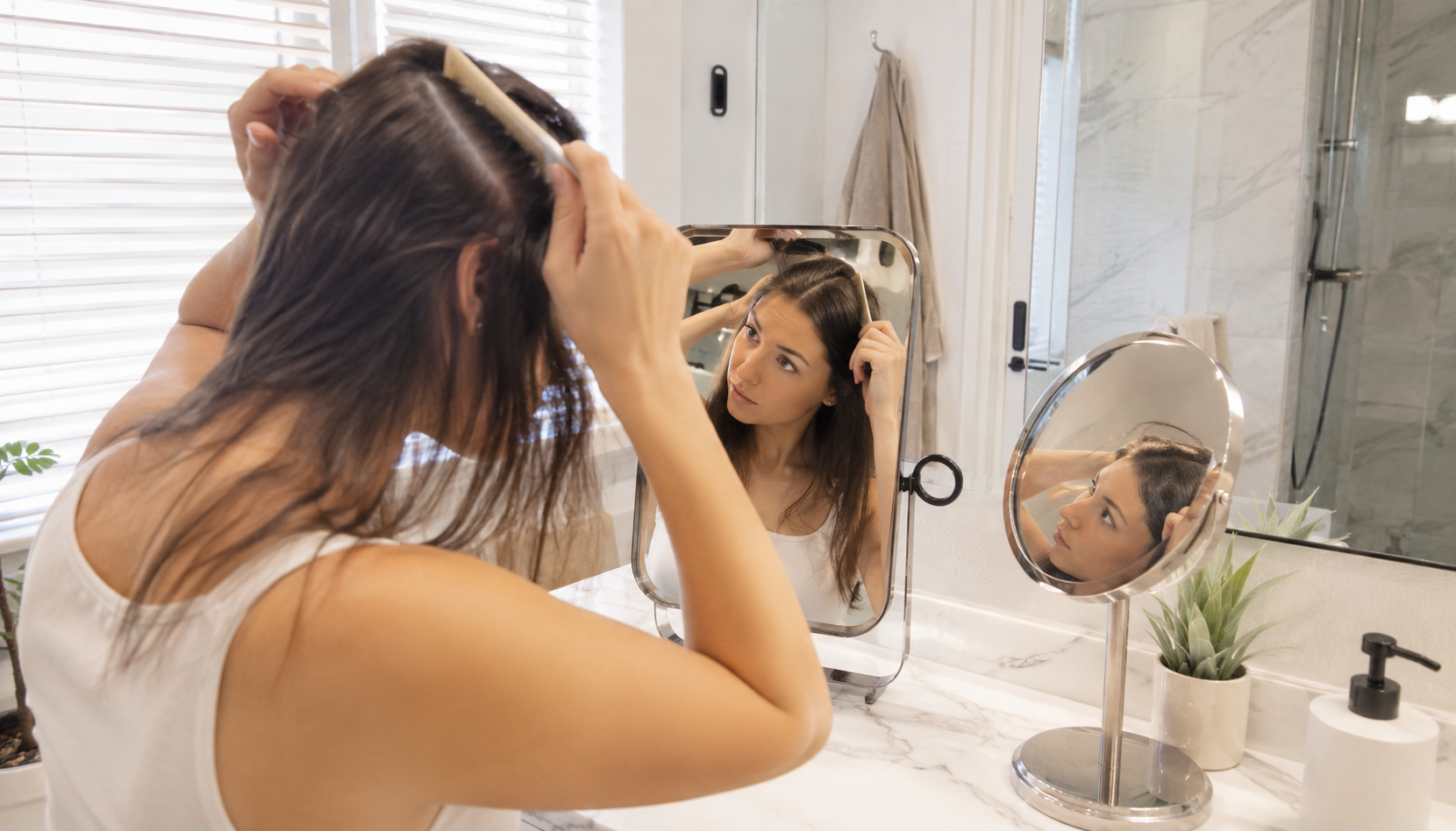

Checking someone else's head for lice is manageable. You can see what you're doing, section the hair properly, and get close enough to spot nits near the scalp. Checking your own head is a different problem.
You can't see the back of your neck. Mirrors create a reversed image that makes it hard to navigate. The hot spots where lice typically concentrate, right at the nape of the neck and behind the ears, are exactly the places you can't easily see on yourself. And because adults often don't expect to get lice in the first place, they wait longer to check, which gives a case more time to develop.
Here's how to actually do it when you're on your own.
What You Need Before You Start
Getting the setup right matters more than most people expect. Trying to check your own head in poor lighting with the wrong tools is how you miss an active case.
What to gather:
- A fine-tooth metal lice comb (plastic combs miss a lot)
- Two mirrors — one to hold, one mounted or propped behind you
- Bright lighting, natural sunlight near a window is best, otherwise a strong lamp aimed at your head
- White paper towels to wipe the comb after each pass
- Hair clips to section as you go
- Conditioner or detangler spray to dampen the hair
The two-mirror setup is essential. Position one behind you at an angle where you can see the nape of your neck reflected in the mirror in front of you. It takes a minute to get right, but without it, you're checking less than half your scalp.
Where Lice Actually Are (So You Know Where to Look)
According to the CDC, lice stay close to the scalp where it's warm. On adults, the highest concentration of nits is almost always at the nape of the neck, behind the ears, and along the hairline. These are the warmest spots and where female lice prefer to lay eggs.
Live lice are harder to spot because they move fast, roughly 23 centimeters per minute. They actively avoid light, so when you part the hair and expose the scalp they scatter. Nits are easier to find because they don't move — they're glued to the hair shaft, usually within a quarter inch of the scalp.
Step-by-Step: Checking Your Own Hair Solo
Step 1: Dampen your hairWet hair slows lice down significantly, making them easier to spot and catch on the comb. Apply conditioner or detangler and work it through. Don't rinse it out.
Step 2: Set up your mirrors and lightingPosition yourself so your back mirror reflects the nape of your neck into your front mirror. Get your light source aimed at your scalp, not your face.
Step 3: Divide the hair into sectionsClip everything up and work in sections roughly two inches wide. Start at the nape of the neck (your highest-risk area) and work forward section by section. Don't rush this part.
Step 4: Comb each section from root to tipPlace the lice comb flat against your scalp and pull through to the ends. After every pass, wipe the comb on a white paper towel and look at what came off. Lice and nits show up clearly against white.
Step 5: Check behind each ear separatelyPart the hair and use your mirror to get a clear look at the skin directly behind each ear. Nits here are easy to miss because they blend into the hairline.
Step 6: Check what you findIf you spot something attached to a hair shaft close to the scalp that won't slide off easily, it may be a nit. The slide test helps here: try moving it down the shaft with your fingernail. Dandruff and product buildup slide off. Nits don't — they're cemented in place with a protein secretion.
What Lice and Nits Actually Look Like
It's common to confuse nits with dandruff, DEC plugs (small white oily secretions from the scalp's sebaceous glands), or hair casts (thin tubes of keratin that wrap around the hair shaft).
The distinction that matters most: nits are fixed within a quarter inch of the scalp, teardrop-shaped, and won't move when you try to slide them. Dandruff brushes away easily. Hair casts encircle the entire strand and slide freely.
Live adult lice are tan to grayish-brown and roughly the size of a sesame seed. Nymphs (newly hatched lice) are smaller, about the size of a pinhead, and lighter in color. Unhatched nits are yellowish or brown. Empty nit casings (already hatched) appear white or clear.
Why Checking Your Own Head Is Genuinely Hard
Even with the right setup, self-checking has real limitations. You're working at awkward angles, your depth perception is off through mirrors, and standard bathroom lighting is usually too dim to catch translucent eggs on the hair shaft. The back of the neck, which is the most common site for a first nit, is essentially impossible to see accurately through a reflected mirror image.
That's not a reason to skip checking altogether. It's a reason to be realistic about what a solo self-check can and can't confirm. If you've found something you're not sure about, or if you've gone through the steps and still feel uncertain, getting a professional check is faster and more definitive than another hour of bathroom mirror contortions.
When to Call LiceDoctors Instead
If your child has an active case of lice, the odds that you've had head-to-head contact with them are high. In those situations, a professional check on yourself at the same time as the household treatment makes practical sense.
LiceDoctors sends trained technicians to your home 7 days a week. They can check and treat adults in the same visit as children, which is how most household cases actually get fully resolved. A technician can see every section of your scalp clearly, including the spots you can't reach yourself, and give you a definitive answer rather than an uncertain one.
Treatment is chemical-free and comes with a 30-day guarantee. If anything is missed, it's handled at no additional cost.
.webp)
